Terence Tao: Six Math Essentials, Harvard Science Center
| When | Monday, November 16, 2026, 6 PM |
| Where | Hall B, Harvard Science Center, 1 Oxford Street, Cambridge MA |
| Overflow | Hall C, next door; the talk is live streamed there |
| Host | Harvard Book Store, in the Harvard Science Book Talks series |
| Co-hosts | Harvard Division of Science, Harvard Library, Department of Mathematics, CMSA |
| Tickets | Sold out; online sales ended. Stand-by line outside Hall B, admitted first-come if seats remain five minutes before the start |
| Format | In person; in conversation with Lauren K. Williams, then a book signing |
This is a moderated conversation rather than a lecture. Tao is joined by Lauren K. Williams, Dwight Parker Robinson Professor of Mathematics at Harvard — algebraic combinatorics, with connections to shallow water waves, traffic flow, protein synthesis and scattering amplitudes, and a MacArthur and Guggenheim fellow. She is also one of the editors of First Proof, which sets out to give a nuanced assessment of how well AI models can create mathematical proofs, so the AI-and-mathematics thread below is as likely to come from the moderator as from Tao. Her traffic-flow work also meets his dynamics chapter, which uses phantom traffic jams as its example.
Terence Tao (UCLA; Fields Medal, MacArthur, Breakthrough Prize) discusses Six Math Essentials, his first popular math book: six ideas, each named in the publisher's description as a gateway. Numbers to quantitative thinking, algebra to abstraction, geometry to calculating beyond what can be seen, probability to reasoning under uncertainty, analysis to taming the very large and the very small, and dynamics as the mathematics of change.
At the talk
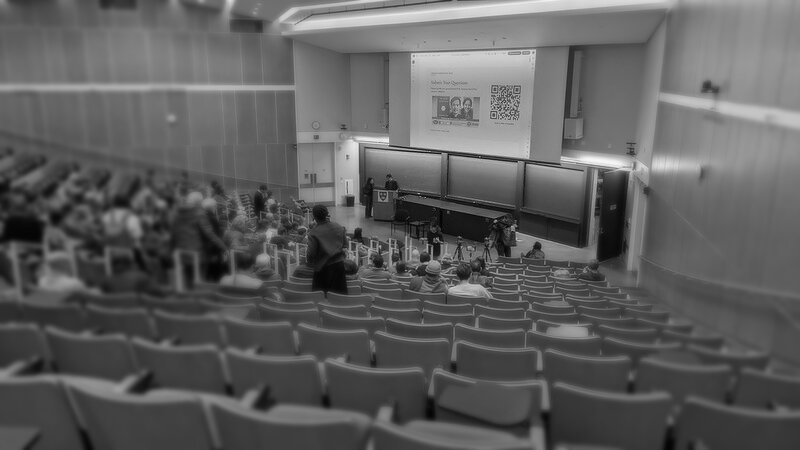
Figure 1: Hall B, filling. Questions were taken by QR code, not from the floor.
It was billed as a book talk and delivered as Math 2.0 — the talk he gave at Caltech in October, re-dated. Six Math Essentials was the occasion, not the subject.
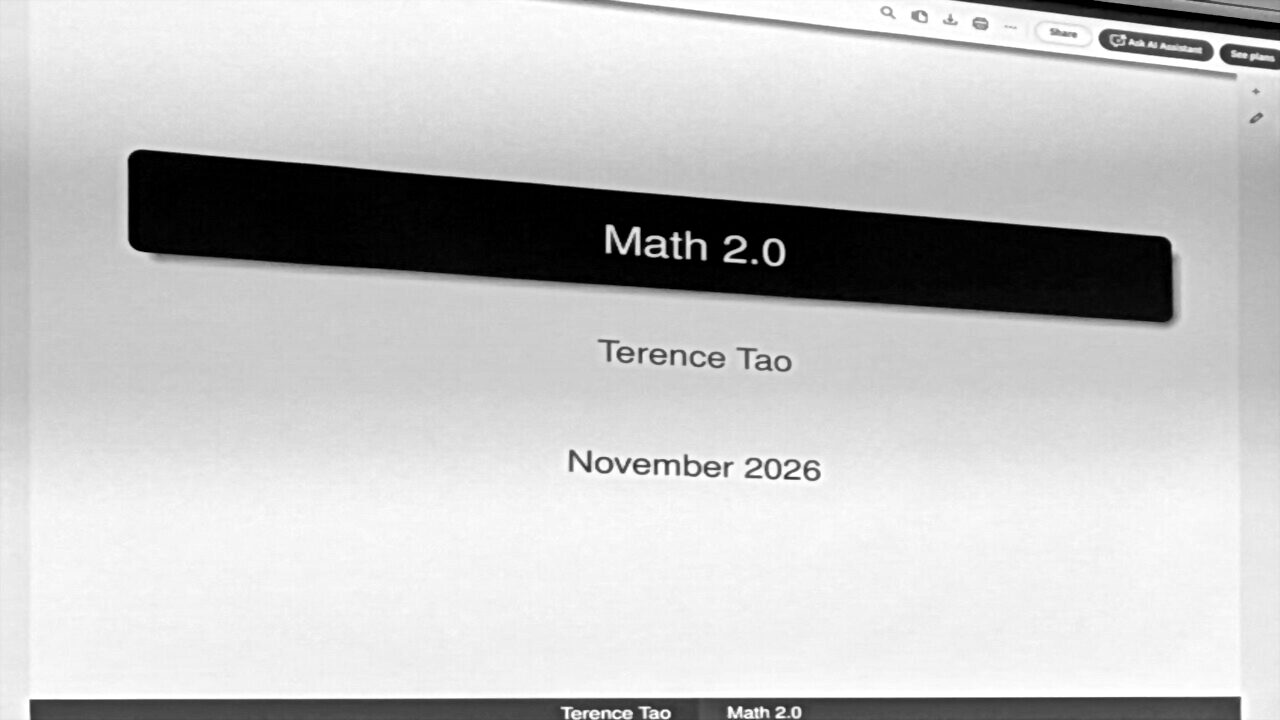
Why mathematics was disrupted first
Math 1.0 ran on proof scarcity: solutions were rare and hard, and "many of the institutions, traditions, incentives, and stated objectives" of the field were organized under that assumption. Three properties then made proofs unusually amenable to machine learning — they are objectively verifiable (different mathematicians disagree about what is interesting, but not about what is correct, and a proof in Lean can be checked mechanically), highly digitizable — no physical instantiation, no real-world input, no experiment — and backed by large high-quality corpora.
That is the incentive story running in both directions, and it is the answer to why a math problem makes such a good oracle: it has a defined answer that a machine can check without asking anyone's opinion. Tao's conclusion is blunt — frontier labs "have thus prioritized advances in mathematical problem-solving capability, ahead of other applications which lack one or more of the above three features". Mathematics was not disrupted because it was important. It was disrupted because it was gradeable.
Why that proxy has gone wrong
Problem-solving, he argues, is "only a proxy for more valuable long-term goals". The proxy was roughly accurate under proof scarcity and has become badly misaligned under proof abundance, to the point that "further blind optimization of problem-solving alone is now actively harmful to the long-term health of mathematics". Math 2.0 therefore means both expanding the research frontier and decentering problem solving.
The sharpest form of this is his reading of open problems as lighthouses: "not destinations to be reached in and of themselves, but useful guides to explore the mathematical landscape around these problems". The lessons from attempting them "are often more valuable than the final solution", so reaching them prematurely by automated tools "can disrupt the exploration of the paths not taken, and sterilize the surrounding field".
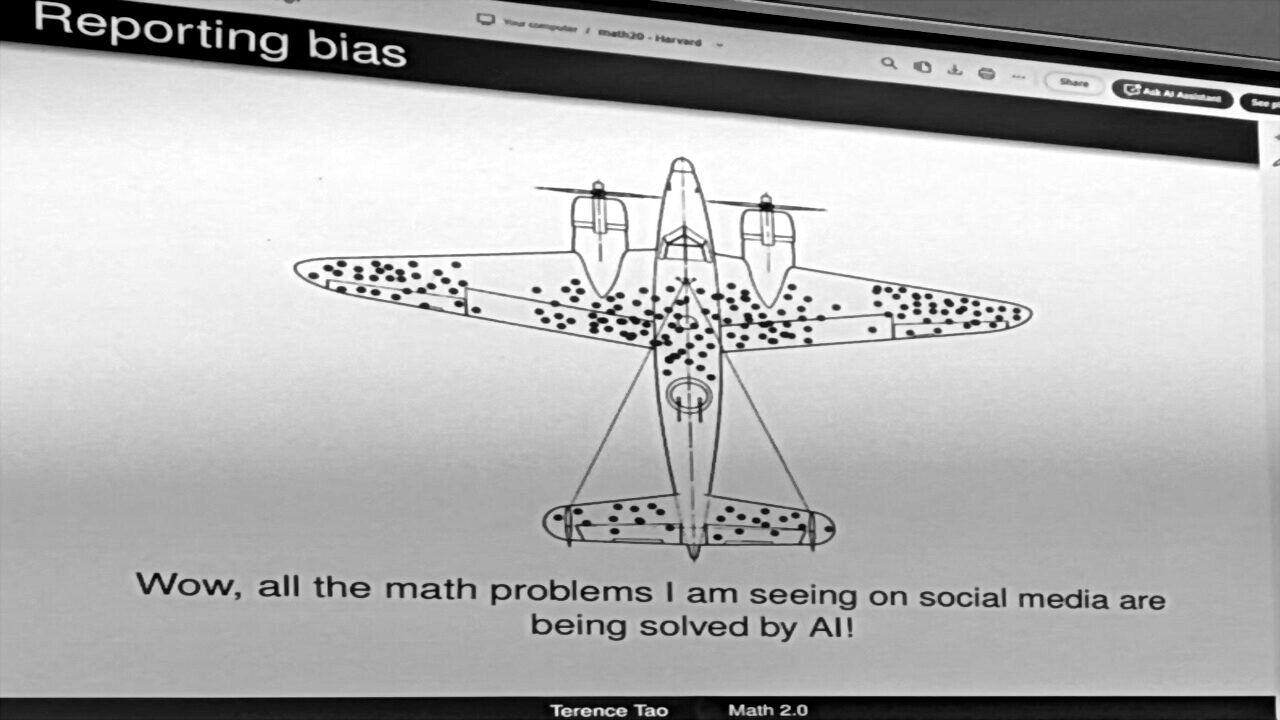
And on how the field's own impression of AI capability is formed, he reuses Wald: the survivorship-bias bomber, captioned "Wow, all the math problems I am seeing on social media are being solved by AI!" The damage is in what does not get posted. He points at First Proof as one effort toward assessments that "fully report key statistics such as resource consumption and negative results" — the project Lauren K. Williams, moderating, helps edit.
Human, AI, and human + AI
The collaboration picture is a Venn: a Humans ellipse and an AI ellipse inside all mathematical tasks, their union labelled Humans + AI and marked as the Math 2.0 research frontier against the Math 1.0 frontier of humans alone. The arrows into it are the interesting part — current press-release and social media activity sits on the overlap, unreported failed AI attempts sit outside it, and the expansion comes from "more imaginative and creative uses of AI".
What that buys is the point the evening kept returning to — not solutions
but understanding. His Math 2.0 diagram puts +AI on every arrow in the
problem-solving ecosystem — applied problems to pure problems, both to human
understanding, human understanding back to both — rather than only on the
arrow from problems to solutions, because "the more sustainable use of AI
would be to strengthen all the ways in which human understanding interacts
with mathematics". The failure mode gets a 2x2: light or heavy AI use against
weak or strong human understanding, giving Pre-math, Misaligned math, Math
1.0 and Math 2.0. Heavy AI with weak understanding is the dangerous cell.
He makes it concrete with a thought experiment that is not about mathematics at all. An AI is asked for a cancer cure that passes a stage 3 trial; it returns a cocktail of previously unknown chemicals, with a Lean certificate, and the trial succeeds. Nobody knows how it was found. Before you accept the injection, would you find it reassuring that at least one human understands — even partially — the mechanism, or the mathematical model used to find it?
What the work looks like
The examples are collaborative by construction and aimed at knowledge rather than answers: the Equational Theories Project settling over 22 million true/false statements in universal algebra by crowdsourcing human and automated arguments; the Inverse Galois Problem challenge; the Caltech Mathathon (November 13–15, days before this talk), built around finding new and better proofs for results whose current proofs are unsatisfying; the Integrated Explicit Analytic Number Theory Network as a living spreadsheet of interconnected results; Mathlib; "open exposition problems" as opposed to open research problems; ablation studies that remove a hypothesis to see what survives. And the summarizing line — using AI to find new "principles, methods, or insights, rather than merely new proofs".
He closes on the constraint: "The primary bottleneck to achieving Math 2.0 is not technology, or even institutional culture. It is imagination."
What generalises beyond mathematics
Mine, not his. The deck's three properties — objective verifiability, digitizability, large corpora — are given as the reason mathematics was disrupted first. They have a second consequence he does not draw out: each one also makes the artifact cheap to regenerate. Once a discovery path is known, a system can produce a near-identical implementation of it at will. The scarce thing was never the artifact; it was the route to it, and the understanding picked up along the way.
So any reward system that scores the artifact while ignoring the context of its discovery is now measuring the wrong quantity. It pays for arrival, which has become cheap, and not for the route, which has not. This is not a mathematics problem. It is a property of any field where verification is cheap and regeneration is cheap — which is to say, exactly the fields that are most exposed to this disruption in the first place. The susceptibility and the incentive failure have the same cause.
The apparent fix is worse than the disease. Faced with cheap regeneration, the instinct is to nail down priority: timestamp the result, publish a hash of it, sign it, hold the discovery back until the claim is staked. That answers "who won" with cryptographic precision — and "who won" is precisely the misaligned metric. It makes the wrong measurement more rigorous, and it buys that rigour by suppressing, for the duration of the embargo, the teaching, explanation and collaboration that were the part worth having. A signing key can establish that you held a string first. It cannot establish that anyone understood it, which is the thing proof abundance has made scarce.
Read against his own framing, a priority system is anti-lighthouse. If open problems are guides rather than destinations, and the lessons from attempting them are worth more than the solution, then a scheme that rewards reaching the destination first and conceals the attempt is optimising against the only thing he says still has value.
Before the talk
Tao has written in public about AI and mathematics this year; the September 6 brief carries his post on solving problems "by purely AI-powered methods". A question worth bringing: which of the six ideas does he think a model handles least well, and why. A second, from the guest essays: the book is about what mathematics is for a reader who will not prove anything, which is the question forty-six mathematicians just answered on his blog for the people who do.
Six months of context
The talk is about a book of six ideas. The six months before it were about something else. Until September the blog was the usual mix: papers, "digestions" of results other people had found (unit distances, the Jacobian conjecture counterexample, the HRT counterexample, Sendov's conjecture), and small visualizers he built with coding agents. The August Kakeya post is the popular article the ICM asked him to write for Hong Wang, one of the four 2026 Fields medallists.
From 10 September most posts are guest essays, forty-six in under six weeks, most of them on what AI means for mathematics: from Fields medallists (Gowers, Hairer), a department chair, the Hodge conjecture's specialists, an open-letter coalition and an advisory group. His own posts in the same weeks are reading lists, statements, competitions and formal-proof infrastructure (SAIR's Open Math Model and Open Math OS, How to Formalize All of Mathematics). The research did not stop: the Euler blowup paper, and notes for his graduate course 247A.
The news around it ran the same way. Labs announced results in batches and withdrew some, the Clay Institute issued a Navier–Stokes announcement, and the field argued in public about credit, standards and what a theorem is for.
His own posts
All 38 posts on his blog in the window that are not marked as guest posts.
Guest posts on his blog
Forty-six. Read together, most of them are the profession's answer to the question in Before the talk.
Tao elsewhere
AI results, and the dispute over them
Results and prizes
Notes
Notes pending.